
UNLOCK YOUR REAL ESTATE SUCCESS

RETI Blog

Real estate agent and client shaking hands across a desk with a model house in the foreground, symbolizing a successful property transaction, agreement, or listing appointment. Bright office setting with a professional and welcoming atmosphere.

How to Handle Real Estate Objections Without Losing Listings

June 18, 20266 min read

Why Most Real Estate Agents Lose Listings During Objections (And How to Fix It)

Why Most Real Estate Agents Lose Listings During Objections (And How to Fix It) Few things feel worse than walking out of a listing appointment knowing you were close to securing the mandate… only to lose it because of one objection. Maybe the seller said your commission was too high. Maybe they wanted to "think about it." Maybe they mentioned another agent they were considering. Or perhaps they felt your recommended price was too low. Whatever the objection, many agents experience the same thing. Their confidence drops. They start defending themselves. They talk too much. They discount their value. Or they simply don't know what to say next. The reality is that objections are part of real estate. The difference between agents who consistently win listings and those who regularly lose them often comes down to one skill: How they handle objections. The good news? Objection handling is not a talent you're born with. It's a skill you can learn. Objections Are Not Rejections One of the biggest mindset shifts any real estate agent can make is understanding that objections are not rejections. Most sellers aren't trying to reject you. Most buyers aren't trying to make your life difficult. Most prospects aren't saying "no." They're saying: "I need more certainty." In many cases, objections are simply signs that the client needs more information, more confidence, or more trust before making a decision. When we understand this, we stop taking objections personally. And when we stop taking them personally, we can start handling them professionally. What Is Really Behind Most Objections? When sellers hesitate, buyers delay, or prospects push back, they are usually communicating one of three things: 1. They Don't Fully Understand the Value People are comfortable paying for things they understand. When a seller questions your commission, the issue is often not the commission itself. The issue is that they don't yet understand the value behind it. If someone sees clear value, price becomes far less important. 2. They Feel Uncertain About the Decision Buying or selling property is a significant financial decision. Uncertainty is natural. Sometimes objections are simply a client's way of slowing down the process while they gather confidence. 3. They Need More Trust Real estate is a relationship business. Clients need to trust that you understand their situation, have their best interests at heart, and can guide them through the process. Until that trust exists, objections will continue to appear. The Biggest Mistake Agents Make During Objections  Most agents try to answer objections too quickly. The moment an objection appears, they immediately jump into defence mode. They start: Explaining their commission Defending their recommended price Talking excessively Becoming pushy Discounting their fees too quickly Unfortunately, this often creates even more resistance. Why? Because they are responding to the objection they heard instead of the concern behind the objection. The objection is often just the symptom. The uncertainty is the real issue. A Simple Example Imagine a seller says: "Another agent is charging less commission than you." Many agents immediately begin explaining why their commission is justified. But what if the real concern isn't the commission at all? What if the seller is actually wondering: "How do I know you're worth the difference?" Those are two very different conversations. The most successful agents understand that their first job is not to defend. Their first job is to understand. Great Agents Stay Curious Top-performing agents approach objections differently. Instead of becoming emotional, they become curious. They stay calm. They listen carefully. They ask thoughtful questions. They seek to understand the real concern before attempting to provide a solution. This allows them to guide the conversation instead of reacting to it. And that is where confidence starts to grow. Confidence Comes From Preparation  One of the biggest reasons agents fear objections is because they don't feel prepared. When you don't know how to respond, every objection feels personal. Every challenge feels uncomfortable. Every difficult conversation feels like a threat. But when you understand the principles behind objection handling, everything changes. You stop feeling defensive. You stop panicking. You stop seeing objections as obstacles. Instead, you start seeing them as opportunities to build trust. Because confidence is not about being fearless. Confidence is trusting yourself enough to navigate the conversation professionally. And that confidence comes from preparation, practice, and implementation. Why Objection Handling Matters More Than Ever  In today's market, buyers and sellers have access to more information than ever before. They compare agents. They research commissions. They question pricing recommendations. They challenge marketing strategies. The agents who thrive are not necessarily the agents with the most experience. They are the agents who know how to communicate value, build trust, and guide conversations confidently. That skill can influence: The number of listings you secure Your conversion rate Your commission retention Your client relationships Your overall confidence as an agent In many cases, the outcome of a deal is determined by how effectively an objection is handled. Key Takeaway Objections are rarely about commission, price, timing, or another agent. Most objections are simply requests for more certainty. The agents who consistently win listings are not necessarily the agents with the best scripts. They are the agents who know how to build trust, uncover concerns, and confidently guide conversations. When you stop seeing objections as rejection and start seeing them as opportunities to create clarity, everything changes. Action Steps Write down the three objections you hear most often. Identify what uncertainty may be hiding behind each objection. Practice asking one follow-up question before responding to an objection. Review your last lost listing and identify the real concern behind the objection. Commit to improving one communication skill this week. Remember: You are not set apart from your goals by a matter of time. You are set apart from your goals by a matter of action. Want to Go Deeper? Knowing that objections are not rejections is an important first step. Knowing exactly how to uncover the real concern, build trust, and confidently navigate difficult conversations is what turns that knowledge into results. Inside the IMPLEMENT Membership, we cover practical communication strategies, confidence-building techniques, pricing conversations, listing presentations, and real-world tools that help agents handle objections more effectively and secure more listings. The IMPLEMENT Membership is built around 10 focus areas including Positioning, Content, Lead Generation, Communication, Listings, Pricing, Marketing, Visibility, Tech Integration, and Legacy. If you're ready to step up, skill up, and tech up, the IMPLEMENT Membership provides ongoing training, live sessions, practical tools, and implementation support designed specifically for real estate agents. Learn More  Learn more about the IMPLEMENT Membership here: https://reti.co.za/implement Because learning is valuable. But implementation is what changes your business.



Few things feel worse than walking out of a listing appointment knowing you were close to securing the mandate… only to lose it because of one objection.

Maybe the seller said your commission was too high.

Maybe they wanted to "think about it."

Maybe they mentioned another agent they were considering.

Or perhaps they felt your recommended price was too low.

Whatever the objection, many agents experience the same thing. Their confidence drops. They start defending themselves. They talk too much. They discount their value. Or they simply don't know what to say next.

The reality is that objections are part of real estate.

The difference between agents who consistently win listings and those who regularly lose them often comes down to one skill:

How they handle objections.

The good news?

Objection handling is not a talent you're born with.

It's a skill you can learn.

Objections Are Not Rejections

Real estate agent looking concerned while working on a laptop, surrounded by speech bubbles showing common seller objections including 'Your commission is too high,' 'We want to think about it,' and 'We're speaking to another agent.'

One of the biggest mindset shifts any real estate agent can make is understanding that objections are not rejections.

Most sellers aren't trying to reject you.

Most buyers aren't trying to make your life difficult.

Most prospects aren't saying "no."

They're saying:

"I need more certainty."

In many cases, objections are simply signs that the client needs more information, more confidence, or more trust before making a decision.

When we understand this, we stop taking objections personally.

And when we stop taking them personally, we can start handling them professionally.

What Is Really Behind Most Objections?

When sellers hesitate, buyers delay, or prospects push back, they are usually communicating one of three things:

1. They Don't Fully Understand the Value

People are comfortable paying for things they understand.

When a seller questions your commission, the issue is often not the commission itself.

The issue is that they don't yet understand the value behind it.

If someone sees clear value, price becomes far less important.

2. They Feel Uncertain About the Decision

Buying or selling property is a significant financial decision.

Uncertainty is natural.

Sometimes objections are simply a client's way of slowing down the process while they gather confidence.

3. They Need More Trust

Real estate is a relationship business.

Clients need to trust that you understand their situation, have their best interests at heart, and can guide them through the process.

Until that trust exists, objections will continue to appear.

The Biggest Mistake Agents Make During Objections

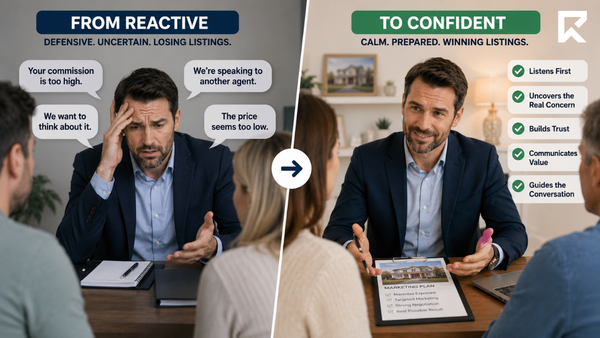
Side-by-side comparison of a reactive and a confident real estate agent, demonstrating how effective objection handling, active listening, and trust-building help agents win more listings.

Most agents try to answer objections too quickly.

The moment an objection appears, they immediately jump into defence mode.

They start:

  • Explaining their commission

  • Defending their recommended price

  • Talking excessively

  • Becoming pushy

  • Discounting their fees too quickly

Unfortunately, this often creates even more resistance.

Why?

Because they are responding to the objection they heard instead of the concern behind the objection.

The objection is often just the symptom.

The uncertainty is the real issue.

A Simple Example

Imagine a seller says:

"Another agent is charging less commission than you."

Many agents immediately begin explaining why their commission is justified.

But what if the real concern isn't the commission at all?

What if the seller is actually wondering:

"How do I know you're worth the difference?"

Those are two very different conversations.

The most successful agents understand that their first job is not to defend.

Their first job is to understand.

Great Agents Stay Curious

Top-performing agents approach objections differently.

Instead of becoming emotional, they become curious.

They stay calm.

They listen carefully.

They ask thoughtful questions.

They seek to understand the real concern before attempting to provide a solution.

This allows them to guide the conversation instead of reacting to it.

And that is where confidence starts to grow.

Confidence Comes From Preparation

Real estate agent sitting at a table with a couple during a property consultation, discussing documents and building trust during a listing appointment.

One of the biggest reasons agents fear objections is because they don't feel prepared.

When you don't know how to respond, every objection feels personal.

Every challenge feels uncomfortable.

Every difficult conversation feels like a threat.

But when you understand the principles behind objection handling, everything changes.

You stop feeling defensive.

You stop panicking.

You stop seeing objections as obstacles.

Instead, you start seeing them as opportunities to build trust.

Because confidence is not about being fearless.

Confidence is trusting yourself enough to navigate the conversation professionally.

And that confidence comes from preparation, practice, and implementation.

Why Objection Handling Matters More Than Ever

In today's market, buyers and sellers have access to more information than ever before.

They compare agents.

They research commissions.

They question pricing recommendations.

They challenge marketing strategies.

The agents who thrive are not necessarily the agents with the most experience.

They are the agents who know how to communicate value, build trust, and guide conversations confidently.

That skill can influence:

  • The number of listings you secure

  • Your conversion rate

  • Your commission retention

  • Your client relationships

  • Your overall confidence as an agent

In many cases, the outcome of a deal is determined by how effectively an objection is handled.

Key Takeaway

Objections are rarely about commission, price, timing, or another agent.

Most objections are simply requests for more certainty.

The agents who consistently win listings are not necessarily the agents with the best scripts.

They are the agents who know how to build trust, uncover concerns, and confidently guide conversations.

When you stop seeing objections as rejection and start seeing them as opportunities to create clarity, everything changes.

Action Steps

  1. Write down the three objections you hear most often.

  2. Identify what uncertainty may be hiding behind each objection.

  3. Practice asking one follow-up question before responding to an objection.

  4. Review your last lost listing and identify the real concern behind the objection.

  5. Commit to improving one communication skill this week.

Remember:

You are not set apart from your goals by a matter of time.

You are set apart from your goals by a matter of action.

Want to Go Deeper?

Knowing that objections are not rejections is an important first step.

Knowing exactly how to uncover the real concern, build trust, and confidently navigate difficult conversations is what turns that knowledge into results.

Inside the IMPLEMENT Membership, we cover practical communication strategies, confidence-building techniques, pricing conversations, listing presentations, and real-world tools that help agents handle objections more effectively and secure more listings.

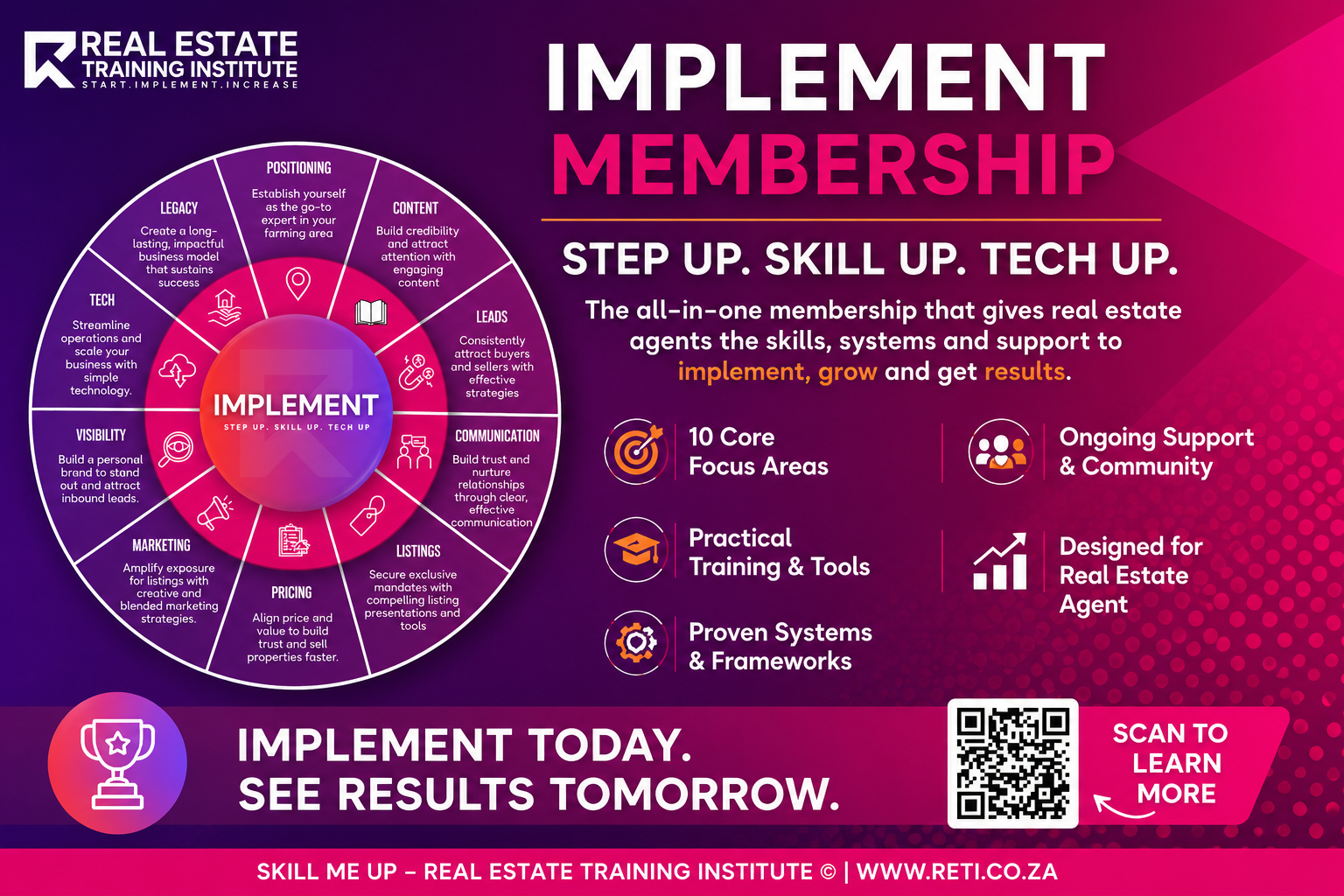
The IMPLEMENT Membership is built around 10 focus areas including Positioning, Content, Lead Generation, Communication, Listings, Pricing, Marketing, Visibility, Tech Integration, and Legacy.

If you're ready to step up, skill up, and tech up, the IMPLEMENT Membership provides ongoing training, live sessions, practical tools, and implementation support designed specifically for real estate agents.

Learn More

Real Estate Training Institute IMPLEMENT Membership infographic showing 10 core focus areas including positioning, content, leads, communication, listings, pricing, marketing, visibility, technology, and legacy, with the tagline 'Step Up. Skill Up. Tech Up.'

Learn more about the IMPLEMENT Membership here:

https://reti.co.za/implement

Because learning is valuable.

But implementation is what changes your business.

Nicolene HamatyRETIReal estate objectionsObjection handling in real estateReal estate listing objectionsHow to handle objections in real estateReal estate agent communication skillsWinning more listingsListing presentation tipsReal estate sales techniquesListing appointmentProperty seller concernsPricing objectionsReal estate commission value
blog author image

Nicolene Hamaty

Nicolene Hamaty, a distinguished Real Estate Trainer and Expert with a wealth of experience. Formerly leading training and education for a renowned real estate brand, she specialises in developing courses and manuals for Property Practitioners. Nicolene's expertise spans Real Estate, Sales, Personal Development, Productivity, Social Media Marketing, and Innovative Strategies, making her a sought-after Motivational Speaker. As a Qualified Property Practitioner, Nicolene holds NQF 4 and NQF 5 certifications in Real Estate, along with PDE 4 and PDE 5 qualifications. Her impressive career in Real Estate dates back to 2008. With a BA in Communication Science, an Advanced Diploma in Real Estate, and NQF 4 in Auctioneering Support Services, she is also a skilled Assessor and Moderator. Nicolene's commitment to excellence led her to establish the Real Estate Training Institute, offering multiple real estate training and courses for Property Practitioners to access training anytime, anywhere. As an NLP Practitioner and Life Coach, Nicolene brings a holistic approach to her training, mentoring, and speaking engagements, establishing her as a well-established expert and leader in the industry.

Back to Blog

Free Marketing Checklist

Download Your 12-Week Marketing Plan Checklist Now: Craft and Monitor Your Real Estate Marketing Activities!

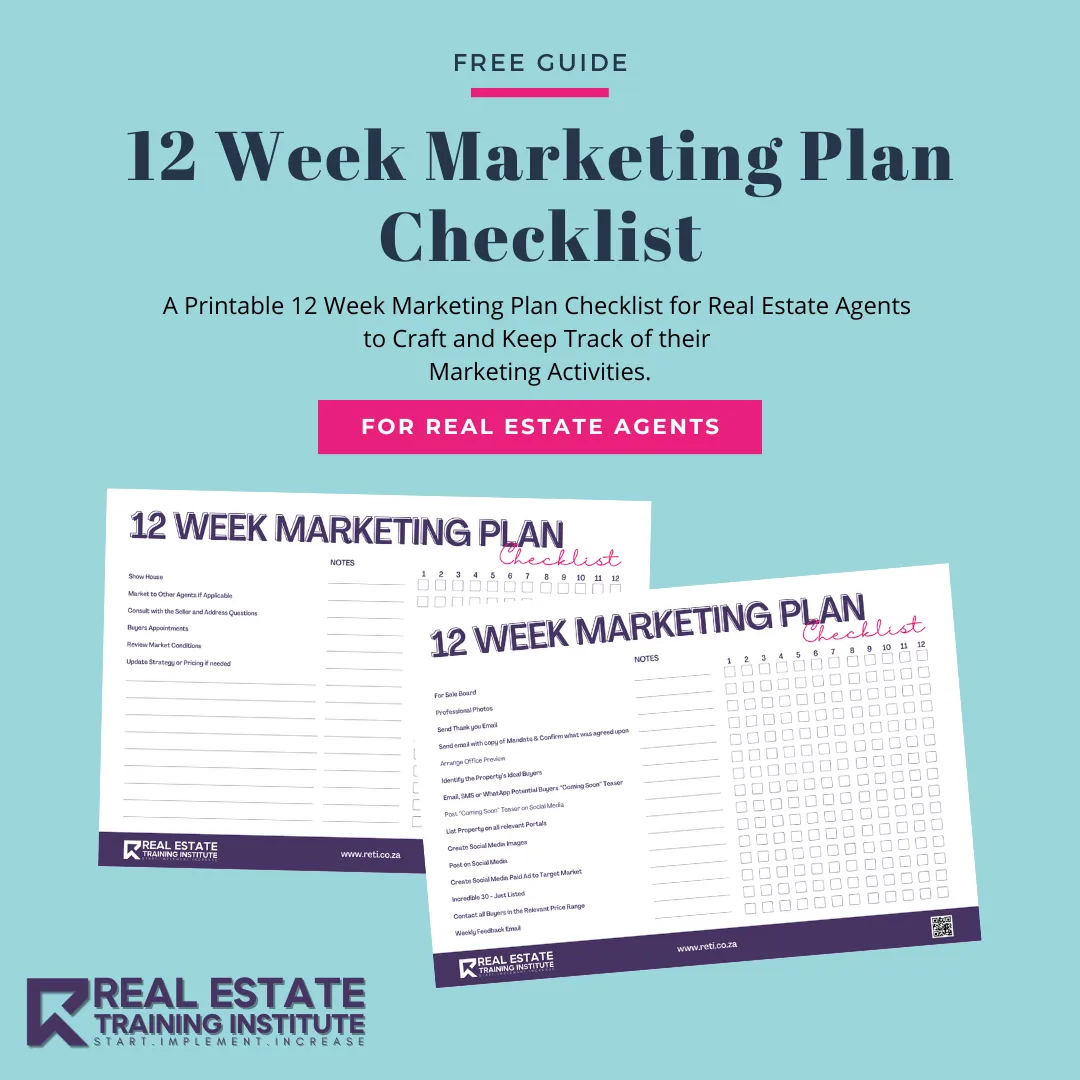
Use the 12 Week Marketing Plan Checklist to plan your marketing activities or to keep track of every marketing action you take. The Checklist provides the minimum marketing activities you should action for every listing and also provides a section for you to add your own marketing activities.

Explore Our Range of Courses

RETI provides comprehensive training and resources to help Agents at all stages of their careers. Whether you are just starting out in the industry or looking to take your Real Estate business to the next level, RETI offers a range of courses and resources to help you achieve your goals. RETI provides practical and actionable insights on a wide range of topics, including marketing, sales, negotiations, running a real estate office and more.

@ Copyright 2023 - 2026 Skill Me Up - Real Estate Training Institute | All rights reserved | Terms of Use & Privacy Policy